Hiking & Trails: Technical Realities of Nordic Footways
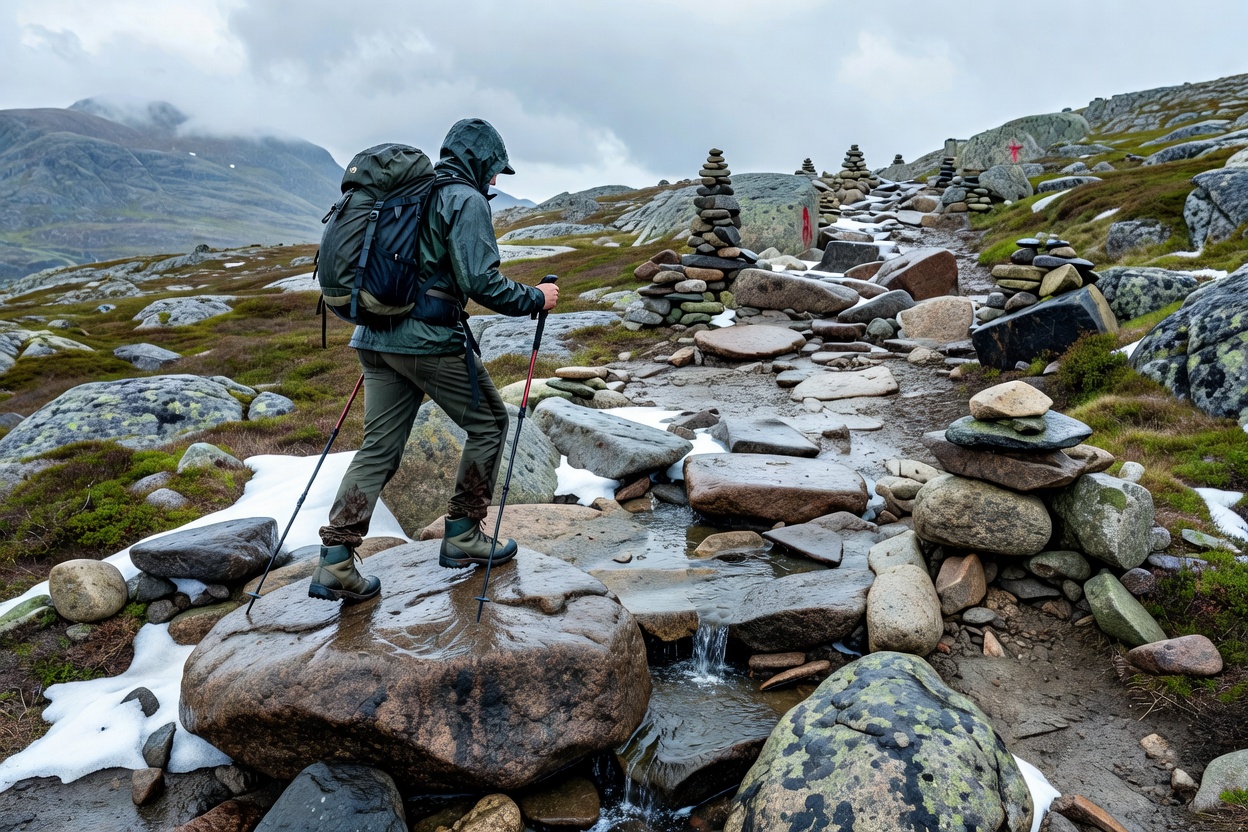
Scandinavian hiking differs significantly from manicured park systems. Ground surfaces are naturally rough, unbridged river crossings are routine, and trail markers can vanish under sudden alpine mist.
The Crucial Distinction: Distance vs. Effort
Do not calculate progress using horizontal kilometers alone. A 12-kilometer stage across granite scree and saturated peat bog can require eight hours of continuous exertion. In contrast, 12 kilometers along a Danish sandy pine track requires under three hours.
Always evaluate trail difficulty by compounding three factors: horizontal distance, cumulative vertical climb, and technical terrain roughness.
Trail Classification and Waymarking Standards
Understanding official trail markers prevents severe navigation errors in low-visibility situations:
- Norway (DNT System): Marked summer routes feature red painted "T" letters on rocks, boulders, and cairns. In winter, winter routes are marked temporarily with dried birch branches jammed into the snowpack. Red T markers are spaced for clear weather line-of-sight; in heavy fog, you must rely on compass bearings.
- Sweden (Fjällleder): Mountain trails are marked with orange or red paint bands around birch trunks in valleys, and red wooden crosses affixed to poles across open plateaus. These red crosses signify winter snowmobile/ski routes that frequently pass directly over deep bogs and frozen lakes unsafe for summer hiking. Summer footways follow cairns with red or orange paint.
- Denmark: Lowland trails use wooden posts with colored arrow discs (yellow, blue, or green). Trails are generally distinct, clear, and well-graded.
Technical Terrain Challenges
Wilderness trails in Nordic parks expose hikers to specific terrain hazards:
Blockfields (Ur)
Miles of jagged, unstable granite rocks produced by frost-wedging. Boulders shift under body weight. Wet lichen creates extreme slip risk. Stiff-soled trekking boots with ankle support and vibram lugs are essential.
Bogs & Wetland Planks (Spångar)
Wet peat bogs are crossed using narrow double or single parallel timber planks. When wet or covered in frost, these planks become slick. Walking poles with mud baskets provide critical balance.
Unbridged River Fording (Vad)
Fast-flowing glacial melt streams must be waded on foot. Water temperatures sit near 2°C. Never unbuckle your hip belt in a river; if you fall, you must shed your heavy pack instantly. Always wear dedicated neoprene or mesh wading shoes.
Navigation & Emergency Protocols
Never rely solely on a smartphone GPS in Nordic backcountry. Cold temperatures drain lithium batteries within hours. In heavy precipitation, capacitive touchscreens fail to respond.
- Always carry a waterproof 1:50,000 scale topographic paper map (Norge-serien or Calazo Fjällkartor) and a magnetic fluid compass.
- Before departure, calculate magnetic declination adjustments (minimal in central Scandinavia, but increasing in northern latitudes).
- If you lose trail markings in fog: stop walking immediately. Check your compass. Backtrack to the last confirmed cairn. Do not push blindly down unknown valleys, which frequently terminate in impassable canyon falls.
Good For
- Hikers capable of self-arresting on steep scree slopes.
- Trekkers comfortable managing wet footwear and damp gear in mountain huts.
- Outdoor enthusiasts who prioritize natural terrain over manicured timber paths.
What to Know
- Many national park river bridges are seasonal and dismantled by late September.
- Summer trails can become totally obscured by unseasonal July snowstorms.
- Cell coverage drops completely within 2 km of leaving roadside trailheads.
Essential Trail Gear Checklist
Maintain this baseline equipment checklist inside all packs entering subalpine or alpine territory:
- Three-layer clothing system: synthetic or merino base, insulating mid-layer (fleece or active wool), 3-layer waterproof/windproof membrane jacket and trousers (minimum 20,000mm hydrostatic head).
- Sturdy high-cut mountain boots with waterproof membranes and rigid torsion-resistant midsoles.
- Personal repair kit: duct tape, multi-tool, spare boot laces, storm matches in waterproof case.
- Emergency bivouac bag (vindsekk) capable of sheltering your entire party during unexpected gales on exposed plateaus.
Questions on Trail Markings or Equipment?
Contact our editorial team with technical inquiries regarding equipment selection or trail marking standards.